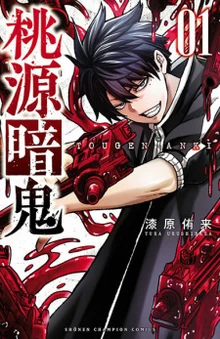
Type: Manga
Status: ongoing
Author(s): URUSHIBARA Yura
Artist(s): URUSHIBARA Yura
Released: 2020
 Support US
Read Tougen Anki Manga Online
Huyết Quỷ Hỗn Chiến, Legend of the Cursed Blood, Tougen Anki: Lanetli İblis Soyu, Tougen Anki: Legend of the Cursed Blood, Tōgen Anki, สงครามเลือดอสูร, 桃源暗鬼
Synposis:
Individuals with Momotarou and Oni blood coursing through their veins maintain a longstanding rivalry. The Oni are careless, rash, and disorderly, while the Momotarou protect the human world from the uncontrollable Oni. Shiki Ichinose is a reckless and irresponsible teenager, aware of his defiance and even proud of his expulsion from school. Despite Shiki's rebellious attitude, his foster father, Tsuyoshi, cares about him deeply.\n\nTsuyoshi's selfless love is soon shown in an explosive incident when a Momotarou barges in looking for Shiki. As a Momotarou himself, Tsuyoshi has been hiding Shiki for years and keeping his Oni origins a secret even from him. As he gives up his life to save Shiki and confesses everything in his dying breath, Shiki's Oni blood awakens for the first time, transforming him into an unruly monster overflowing with rage and a thirst for revenge.\n\nShiki's momentary outburst attracts the attention of Naito Mudano, an Oni teacher at the Rasetsu Academy—an institution for young Oni in need of understanding and perfecting their powers. Before Shiki can avenge his father, he must learn to control his headstrong and impulsive nature and, above all, fight against his own demonic blood.
Type: Manga
Status: ongoing
Author(s): URUSHIBARA Yura
Artist(s): URUSHIBARA Yura
Released: 2020
Tougen Anki Chapters
Tougen Anki: Legend of the Cursed Blood
Tougen Anki: Legend of the Cursed Blood (Japanese: 桃源暗鬼, Hepburn: Tōgen Anki) is a dark fantasy action shōnen manga written and illustrated by Yura Urushibara. Serialized weekly in Akita Shoten’s flagship Weekly Shōnen Champion magazine since June 11, 2020, the series has surpassed 280 chapters and 31 tankōbon volumes in Japan, establishing itself as a pillar of contemporary dark battle manga. Its cross-media footprint is anchored by a high-profile television anime adaptation produced by Studio Hibari.
At its inception, Tougen Anki hooks readers with a classic revenge tragedy rooted in Japanese folklore: Shiki Ichinose, a rebellious teenager unaware of his supernatural lineage, sees his peaceful life shattered when a relentless assassin murders his adoptive father. However, Urushibara rapidly subverts the traditional Momotarō mythos by inverting its moral alignment. Rather than casting the legendary Peach Boy’s descendants as righteous heroes, the series frames the Momotarō Agency as a ruthless, state-adjacent paramilitary organization conducting systematic extermination campaigns against Oni (demons). As Shiki enrolls in Rasetsu Academy to master his volatile bloodline, the narrative expands from a localized vendetta into a sprawling geopolitical conflict exploring systemic prejudice, generational trauma, and the cyclical nature of warfare.
Latest Tougen Anki Updates & Serialization Status
-
Manga Serialization & Volume Cadence: Tougen Anki remains actively serialized on a consistent weekly schedule in Weekly Shōnen Champion, avoiding prolonged hiatuses. In Japan, Akita Shoten releases collected tankōbon volumes roughly every two to three months, pushing past Volume 31. In North America, Yen Press handles the official English print and digital localization, having released Volume 6 in November 2026.
-
Spin-Off Expansion: The franchise expanded its print universe on June 6, 2025, with Tougen Anki Gaiden: Tsuki to Sakura no Kyōsō Kyoku (The Rhapsody of the Moon and Cherry Blossoms), written by Dōma Oda and serialized in Monthly Shōnen Champion.
-
Anime & Multimedia Milestones: The Studio Hibari anime adaptation, directed by Ato Nonaka with music by Kohta Yamamoto, debuted its 24-episode first season from July to December 2025 across Nippon TV, Crunchyroll, Netflix, and Prime Video. Season 2—adapting the Nikko Kegon Falls Arc—premiered in October 2026 for a scheduled 24-episode run through March 2027. Beyond television, the “TOUGEN ANKI Project” encompasses a successful stage play adaptation and TOUGEN ANKI: Crimson Inferno, a multi-platform RPG developed by Com2uS for mobile and Steam.
Story Overview & Core Narrative Arcs
The central narrative follows Shiki Ichinose as he transitions from an impulsive street fighter into a reluctant frontline combatant for the Oni faction. After discovering that his adoptive father, Tsuyoshi, was a former Momotarō operative who defected to raise an Oni child in secret, Shiki is recruited by Naito Mudano into Rasetsu Academy—an underground training institution tasked with weaponizing young Oni before the Momotarō Agency can assassinate them. Across major story arcs—including the Tag Arc, Kyoto Arc, Nerima Arc, Nikko Kegon Falls Arc, and Matsumoto Arc—Shiki and his classmates are thrust into brutal field operations that test their tactical coordination and moral resolve.
-
The Inverted Folklore War: A centuries-old shadow conflict between the descendants of Momotarō and Oni, where historical propaganda masks atrocities committed by both sides.
-
The Kishin Bloodline Burden: Shiki’s status as a “Child of Kishin”—an exceedingly rare Oni capable of wielding apocalyptic, elemental-tier blood abilities—makes him both the Oni faction’s greatest asset and the Momotarō’s primary assassination target.
-
Ideological Fractures Within Rasetsu Academy: Friction among Oni recruits, ranging from pacifists seeking coexistence with humans to extremists demanding total retaliation against Momotarō oppression.
-
Escalating Institutional Warfare: The gradual collapse of secrecy surrounding the supernatural war, forcing civilian populations and government bodies into the crossfire as rogue Momotarō captains escalate attacks.
-
The Ethics of Revenge: Shiki’s internal struggle to avenge his father without succumbing to the mindless berserker rage that historically defined Oni stereotypes.
Main Characters in Tougen Anki
-
Shiki Ichinose: The hot-headed, fiercely loyal protagonist who awakens to his Oni heritage following his adoptive father’s murder. Initially driven by raw fury and reckless bravado, Shiki’s character arc centers on emotional discipline and tactical maturity. As an inheritor of the Kishin bloodline, he struggles to control the overwhelming destructive output of his blood constructs while learning to protect his comrades rather than fighting solely out of hatred.
-
Naito Mudano: Shiki’s stoic, pragmatic instructor at Rasetsu Academy and a high-ranking Oni combatant. Perpetually seen wearing roller skates and wielding an umbrella, Mudano masks deep empathy for his students behind a cold, hyper-efficient exterior. Having lost countless comrades in previous skirmishes, his primary motivation is ensuring his students possess the survival instincts necessary to outlive the war.
-
The Momotarō Agency (Samidare Momoya & Sub-Captains): Serving as the central antagonistic force, the Momotarō Agency is a rigidly structured organization led by ruthless commanders who view Oni as irredeemable pests. Operatives like Samidare Momoya—the assassin responsible for Tsuyoshi’s death—and sadistic researchers such as Kusabi Momoura embody the agency’s ideological fanaticism, though later arcs introduce morally conflicted Momotarō officers who question the agency’s genocidal mandate.
-
Jin Kougasaki: Shiki’s primary rival and classmate at Rasetsu Academy. Cold, calculating, and deeply scarred by family tragedy, Jin initially despises Shiki’s impulsiveness. Over successive combat deployments, their volatile antagonism evolves into a grudging, high-synergy partnership built on mutual survival.
Lore, Power Systems, and World Mechanics
Tougen Anki utilizes a visceral, high-stakes combat system built around biological manipulation, pitting the hemokinetic constructs of the Oni against the bacterial mutations of the Momotarō.
The Power Engine:
-
Blood Eclipse Release (Kesshoku Kaihō): The signature combat technique of the Oni. By drawing their own blood, Oni materialize solid weapons, artillery, or specialized utility constructs tailored to their psychological traits and lineage. Overuse induces severe anemia, organ failure, or involuntary berserker states, forcing fighters to balance offensive output against physical stamina.
-
Momotarō Bacterial Manipulation: In direct contrast, Momotarō operatives control specialized symbiotic bacteria within their bodies. These bacteria allow them to generate elemental phenomena, harden their bodies, or animate inorganic matter and corpses into combat puppets without suffering blood loss.
World Hierarchy & Factions:
-
Rasetsu Academy: The primary educational and military stronghold for Oni youths, structured into combat squads led by veteran field instructors.
-
The Children of Kishin: Eight legendary Oni vessels scattered across Japan who inherit the primal power of the original Oni deities, capable of altering regional battlefields.
-
The Momotarō Agency: Divided into regional branches (such as the Nerima and Kegon Falls divisions), overseen by elite Captains and Sub-Captains who command private tactical units.
Deep Mythos: The universe is anchored in a revisionist interpretation of the Momotarō folktale. Centuries ago, an original Kishin (Demon God) clashed with the progenitor of the Momotarō clan. Rather than ending in decisive peace, the conflict fractured into a covert generational war in which the Momotarō leveraged human societal integration to hunt down scattered Oni bloodlines.
Narrative Framework & Progression Appeal
Urushibara structures Tougen Anki around high-velocity squad tactics and escalating ideological clashes, maintaining strong narrative momentum across more than 280 chapters.
-
Strict Resource Management in Combat: Because Oni abilities literally consume the user’s life force (blood), fights function as tense battles of attrition where reckless attacks lead to physical collapse.
-
Creative Arsenal Specialization: Every character’s Blood Eclipse Release manifests uniquely—ranging from Shiki’s heavy firearms and Naito Mudano’s umbrella to Kyoya Oiranzaka’s blood-ingested invisibility—rewarding creative counter-play over raw power levels.
-
Ensemble Squad Dynamics: Rather than isolating the protagonist, major arcs rotate spotlight focus across Rasetsu Academy’s roster, giving supporting characters full tactical matchups and character growth.
-
Moral Grayness Over Cartoonish Evil: Key arcs deliberately humanize select Momotarō operatives while exposing ruthless extremists within the Oni ranks, destabilizing reader allegiances.
-
Breakneck Arc Pacing: Transitions between training regimens and live-fire ambush arcs occur swiftly, ensuring narrative stakes continually escalate without filler stagnation.
Franchise Identity & Production Quality
Tougen Anki commands a distinct visual and tonal identity within Weekly Shōnen Champion, blending gritty urban street fashion with macabre supernatural horror. Yura Urushibara’s artwork is characterized by sharp, angular linework, expressive facial distortion during moments of extreme rage, and high-contrast ink shading that emphasizes the visceral nature of blood-based weaponry.
-
Kinetic Action Choreography: Panel layouts prioritize wide, dynamic spreads and clear spatial flow during multi-combatant skirmishes.
-
Distinctive Character Silhouettes: Streetwear-inspired uniforms, tattoos, piercings, and eccentric character quirks give the cast immediate visual memorability.
-
Consistent Creative Vision: Sole authorship by Urushibara ensures uninterrupted thematic cohesion, art consistency, and seamless foreshadowing from Chapter 1 onward.
-
High-Impact Anime Translation: Studio Hibari’s adaptation preserves the manga’s aggressive color palette and crimson visual motifs, reinforced by Kohta Yamamoto’s percussive, high-tempo score.
-
Coordinated Cross-Media Rollout: Synchronized releases across print, stage plays, television anime, and Com2uS’s Crimson Inferno RPG keep the brand continuously visible.
Setting & Societal Impact
Set in contemporary Japan, Tougen Anki operates on a fragile masquerade that deteriorates as the series progresses. Both the Oni and the Momotarō Agency actively conceal their conflict from ordinary citizens, though their methods and societal standing differ drastically.
-
Institutional Assimilation of the Momotarō: The Momotarō Agency holds deep ties to Japan’s political, corporate, and law enforcement infrastructure, allowing them to cover up battle damage as gas leaks or terrorist incidents.
-
Underground Oni Networks: Marginalized and hunted, Oni communities rely on hidden sanctuaries, covert medical clinics, and Rasetsu Academy outposts to survive.
-
Civilian Collateral Tension: Major urban battles—such as the Nerima and Matsumoto incidents—push the secrecy masquerade to its breaking point, threatening mass public panic.
-
Rogue Faction Accelerationism: Radical Momotarō leaders eventually seek to expose Oni publicly to trigger state-sanctioned civilian pogroms.
-
Psychological Toll on Youths: Recruit characters must navigate the dissonance of living as ordinary teenagers while carrying genetic traits that make them state targets.
Why Tougen Anki Is So Popular
-
Subversive Folklore Premise: Flipping Japan’s most famous hero tale into a story about systemic persecution offers an immediately compelling hook for domestic and international audiences alike.
-
Stylish, Visceral Combat Aesthetic: The combination of dark streetwear fashion and creative blood-weaponry resonates strongly with fans of modern dark shōnen such as Jujutsu Kaisen and Chainsaw Man.
-
Unapologetic Dark Shōnen Tone: The series does not shy away from permanent character casualties, body horror, and psychological trauma, raising genuine tension in every encounter.
-
Strong Ensemble Cast Appeal: Distinct character archetypes—from the stoic mentor Mudano to eccentric support fighters like Kyoya Oiranzaka—drive heavy fan-art and character-ranking engagement.
-
Two-Cour Anime Momentum: Consecutive 24-episode anime seasons across 2025 and 2026–2027 on Crunchyroll and Netflix dramatically accelerated global manga readership.
Where to Read Tougen Anki Officially
Readers looking to support creator Yura Urushibara can access Tougen Anki: Legend of the Cursed Blood through verified, official licensing channels:
-
English Print & Digital Volumes: Licensed and published in North America by Yen Press, available in physical paperback and digital editions via major retailers including Amazon, Barnes & Noble, BookWalker, Kindle, and Kobo.
-
Japanese Original Serialization: Published weekly in Akita Shoten’s Weekly Shōnen Champion (print and digital via Champion Cross / Manga Cross), with collected Japanese tankōbon volumes available through Akita Shoten.
-
International Editions: Officially published in French by Kana, as well as localized editions in Italian, Spanish, and German.
Final Thoughts
Tougen Anki has carved out a commanding niche in modern shōnen by pairing classic battle-manga kineticism with a sharp, morally complex deconstruction of Japanese mythology. Rather than relying solely on power-level escalation, Yura Urushibara sustains reader investment through ideological conflict, tactical resource limits, and genuine emotional stakes.
With the manga deep into its high-stakes narrative arcs past Volume 31, a spin-off series running in Monthly Shōnen Champion, and Studio Hibari’s anime adaptation captivating global audiences through its second season, Tougen Anki stands as one of Akita Shoten’s premier modern franchises with substantial runway ahead.